
If you take several medicines each day, you probably know how easy it is to miss a dose, take tablets at the wrong time, or wonder whether you have already taken them.
For many older adults and carers, the hardest part is not taking medication, it is remembering whether it has already been taken.. The challenge is often not taking the medicine itself. The challenge is remembering what to take, when to take it, and making sure nothing gets missed.
Many people tell pharmacists that they spend more time worrying about their medication routine than actually taking their medicines. Questions like:
- Did I take my morning tablets?
- Have I already taken today’s dose?
- Did Mum remember her lunchtime medication?
- Do I have enough medication left for the weekend?
can quickly become part of everyday life.
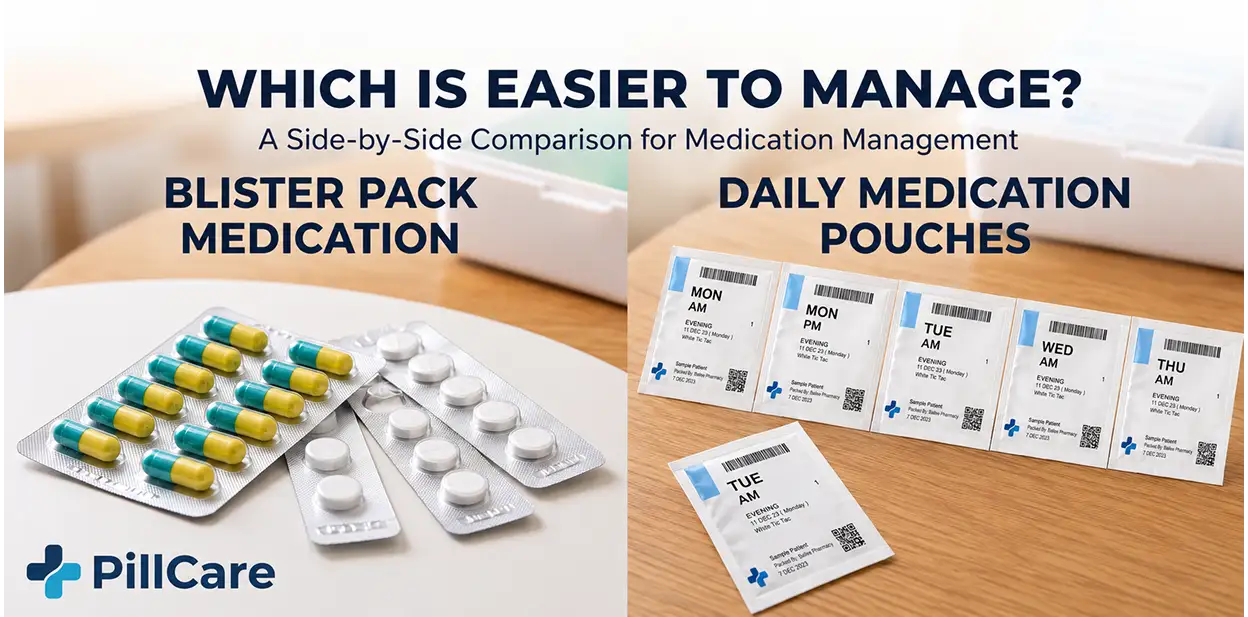
This is why medication management services such as daily medication pouches, blister pack medication, and dosette boxes have become increasingly popular across the UK.
In most cases, people looking for a simpler medication routine find that daily medication pouches are easier to manage because every dose is organised, labelled, and ready to take at the exact time it is needed. However, blister packs and dosette boxes can still be suitable depending on your medication schedule, lifestyle, and support needs.
This guide explains the differences, benefits, and limitations of each option so you can decide which one is most practical for everyday life.
Why Medication Organisation Matters
Managing multiple medicines can be difficult.
This is particularly true for people who:
- Take medicines several times a day
- Manage repeat prescriptions
- Live with memory difficulties
- Support a family member with medication
- Have recently left hospital
- Take medicines for several long-term conditions
Without a clear system, medication errors can happen.
Common problems include:
- Missing doses
- Taking medication twice by mistake
- Mixing up medicines
- Running out of prescriptions
- Forgetting medication when leaving home
Medication organisation systems are designed to improve medication adherence, reduce confusion, and make daily routines easier to follow.
Why More People Are Choosing Daily Medication Pouches
Daily medication pouches have become increasingly popular because they fit naturally into everyday life.
Unlike traditional medication packaging, pouches organise medicines by the exact day and time they need to be taken.
For many people, this removes a large part of the mental load that comes with managing prescriptions.
Daily medication pouches are often helpful if you:
- Take medicines several times a day
- Want a clear medication schedule
- Travel regularly
- Leave the house frequently
- Receive support from a family carer
- Want help managing repeat prescriptions
- Prefer organised, pharmacist-checked medication
Many patients say medication feels easier to manage when every dose is already organised and clearly labelled.
What Are Daily Medication Pouches?
Daily medication pouches are small sealed packets prepared by a pharmacy.
Each pouch contains all the tablets and capsules required for a specific date and time.
For example:
Monday – 8:00am
The pouch contains all medicines due at that time.
Each pouch is clearly labelled and connected together on a roll. When medication is due, you simply tear off the next pouch and take the medicines inside.
Most medication pouch services also include pharmacist checks to help ensure medication is organised accurately according to your prescription.
Many medication pouch services also support repeat prescriptions and home delivery, making it easier to stay on top of regular medicines without needing to organise them yourself.
Why Patients and Carers Often Prefer Medication Pouches
Less Worry About Missed Doses
Every pouch is labelled with the exact date and time medication should be taken.
This helps reduce uncertainty and makes it easier to follow a medication routine.
Easier for Family Carers
One of the most common concerns carers have is whether medication has actually been taken.
Clear labels make it easier to monitor medication schedules and support loved ones.
Better for Complex Medication Schedules
Many people take medicines:
- In the morning
- At lunchtime
- In the evening
- At bedtime
Medication pouches organise these doses clearly and reduce the risk of confusion.
Easier to Take Medication Away From Home
A common complaint we hear from patients using traditional medication trays is that they often need to carry an entire week’s medication for a short trip.
With pouches, you simply take the doses you need.
Supports Independent Living
Many older adults appreciate being able to manage medication more confidently without relying on others to organise tablets every week.
What Is Blister Pack Medication?
Blister pack medication is another form of compliance packaging commonly used by UK pharmacies.
Medicines are organised into a plastic tray with separate compartments for different days and times.
Each compartment is sealed with foil backing.
Patients access medication by pushing tablets through the foil.
Blister packs are often organised into:
- Morning
- Lunchtime
- Evening
- Bedtime
sections for each day of the week.
Benefits of Blister Pack Medication
Easy Weekly Overview
Many patients and carers like being able to see an entire week’s medication in one place.
Helpful for Monitoring Medication
Empty compartments make it easier to see whether medication has been taken.
Professionally Prepared
Like medication pouches, blister packs are organised and checked by pharmacy professionals.
Familiar Format
Blister packs have been used for many years and remain a trusted option for many patients.
Things to Consider Before Choosing a Blister Pack
They Can Be Bulky
Blister packs take up more space than medication pouches.
Many patients find them less convenient when travelling or leaving the house.
Opening Can Be Difficult
People with arthritis, reduced hand strength, or dexterity problems sometimes find foil-backed compartments difficult to open.
Less Flexible for Complex Medication Times
Some medication schedules do not fit neatly into standard morning, lunchtime, evening, and bedtime categories.
Recycling Can Be Challenging
Most blister packs combine plastic and foil materials that cannot usually be recycled through household collections.
What Is a Dosette Box?
A dosette box is a reusable medication organiser divided into compartments for different days and times.
Unlike blister packs and medication pouches, dosette boxes are usually filled by the patient, a family member, or a carer.
Some people choose dosette boxes because they are reusable and easy to adjust when prescriptions change.
However, because medicines are organised manually, there is a greater risk of medication errors.
Benefits of a Dosette Box
- Reusable
- Easy to update when medication changes
- Available in different sizes
- Useful for simple medication routines
Things to Consider Before Choosing a Dosette Box
- Medicines must be sorted manually
- Higher risk of mistakes
- Time-consuming to fill
- Compartments can open accidentally
- No pharmacist check after filling
Comparing Daily Medication Pouches, Blister Packs and Dosette Boxes
| Feature | Daily Medication Pouches | Blister Packs | Dosette Boxes |
| Prepared by pharmacy | Yes | Yes | Usually No |
| Clear date and time labels | Excellent | Good | Depends on user |
| Suitable for travel | Excellent | Fair | Good |
| Suitable for complex medication schedules | Excellent | Good | Fair |
| Easy for carers to monitor | Good | Excellent | Moderate |
| Portable | Excellent | Fair | Good |
| Reusable | No | No | Yes |
| Risk of medication errors | Low | Low | Higher |
| Suitable for multiple daily doses | Excellent | Good | Fair |
Which Option Is Best for Different People?
Older Adults
Many older adults take several medicines throughout the day.
Patients often tell us they want medication to feel simpler and easier to follow. Daily medication pouches can help because every dose is organised in the order it should be taken.
Family Carers
Carers often tell us that checking whether medication has been taken is harder than collecting the prescription itself.
Both blister packs and pouches can help, although pouches are often easier for complex medication schedules.
People With Dementia or Memory Difficulties
Professionally prepared medication packaging can reduce confusion and support medication adherence.
The most suitable option depends on individual needs and available support.
People With Arthritis or Reduced Grip Strength
Many patients find tear-open pouches easier than pushing tablets through foil-backed blister packs.
Frequent Travellers
Medication pouches are often the easiest option because only the required doses need to be carried.
People With Frequent Prescription Changes
Dosette boxes may provide greater flexibility because medication can be adjusted immediately when prescriptions change.
Common Medication Problems These Systems Help Solve
“I Cannot Remember If I Took My Tablets”
This is one of the most common concerns patients raise.
Medication organised by date and time makes it easier to follow a routine.
“My Relative Keeps Missing Medication”
Clear medication organisation can make daily schedules easier to manage.
“I Do Not Want to Carry Multiple Boxes of Medication”
Many people prefer pouches because they are compact and easy to carry.
“I Take Too Many Medicines to Keep Track Of”
Medication packaging systems reduce the need to sort multiple medicines every day.
Medication Changes After a Hospital Stay
Medication often changes after:
- Hospital discharge
- Specialist appointments
- Medication reviews
- GP consultations
This is a common issue after a hospital stay, when medicines are often changed or added.
Before moving to a medication pouch service, blister pack, or another medication management system, a pharmacist should review your medication to ensure it remains suitable.
A pharmacist can also advise which option is most appropriate while prescriptions stabilise.
What Medicines Usually Stay in Their Original Packaging?
Not every medicine can be added to medication pouches or blister packs.
Examples may include:
- Inhalers
- Eye drops
- Creams and ointments
- Liquid medicines
- Refrigerated medicines
- Certain moisture-sensitive tablets
- Some short-term medicines
Your pharmacist will advise which medicines need to remain in their original packaging.
How Medication Pouches and Blister Packs Are Prepared
Most pharmacy-managed medication packaging services follow a similar process.
- A pharmacist reviews the prescription.
- Medicines are organised according to the medication schedule.
- Accuracy checks are completed.
- A final pharmacist verification takes place.
- Medication is prepared for collection or home delivery.
This process helps reduce medication errors and supports safer medication management.
NHS and Pharmacy Support in the UK
If managing medication has become difficult, your local community pharmacy may be able to help.
Depending on your needs, pharmacy services may include:
- Daily medication pouches
- Blister pack medication
- Repeat prescription management
- Prescription collection services
- Home delivery services
- Medication reviews
Availability varies across the UK and between pharmacies.
Some services may be offered through local community pharmacies, while others may be available through specialist medication pouch providers.
If you are unsure which option is right for you, speak with a pharmacist who can review your medication routine and discuss available support.
Travelling With Medication
For many people, medication needs to fit around everyday life.
Whether you are travelling, visiting family, attending appointments, or spending the day out, carrying medication should be simple.
Many people prefer pouches because they can take only the doses they need rather than carrying a full week’s medication.
When travelling:
- Keep medicines stored safely.
- Carry essential medicines in your hand luggage when flying.
- Keep medicines in clearly labelled packaging.
- Check medication requirements before travelling abroad.
Medication Packaging and Recycling
Packaging waste is becoming an increasingly important consideration for many patients.
Blister Packs
Most blister packs combine plastic and foil materials and cannot usually be recycled through standard household recycling collections.
Some community pharmacies offer specialist blister pack recycling schemes.
Daily Medication Pouches
Medication pouches generally use less material than large blister trays, although they still create single-use packaging waste.
Dosette Boxes
Dosette boxes can be reused for many years, helping reduce packaging waste over time.
If recycling is important to you, ask your local pharmacy whether recycling options are available in your area.
Frequently Asked Questions
A blister pack stores medication in separate sealed compartments within a tray. A medication pouch contains all medicines required for a specific date and time inside a labelled packet.
Yes. Many community pharmacies and specialist pharmacy providers offer medication pouch services across the UK.
Many older adults find medication pouches easier to manage, particularly when taking medicines several times throughout the day.
Yes. Many carers find medication pouches helpful because every dose is clearly labelled with the exact date and time.
No. Some medicines must remain in their original packaging due to storage requirements or manufacturer guidance.
Yes. Medication pouches are often popular with travellers because they are compact and easy to carry.
If your medication changes, your pharmacist can review your medication packaging and advise how future pouches or blister packs will be updated.
Neither option is right for everyone. However, many people taking multiple medicines each day find medication pouches easier to manage because each dose is labelled with the exact date and time it should be taken.
Many people with arthritis or reduced hand strength find medication pouches easier to open than foil-backed blister packs.
Looking for a Simpler Way to Manage Medication?
If managing multiple medicines feels overwhelming, daily medication pouches can make your routine easier. Each pouch is clearly labelled with the exact date and time your medicines should be taken, helping reduce confusion and support medication adherence.
Our medication pouch service includes pharmacist-checked medication, repeat prescription support, and convenient home delivery, helping you stay organised without the hassle of sorting tablets yourself.
To find out whether medication pouches are suitable for you or a loved one, speak with our pharmacy team today.
