
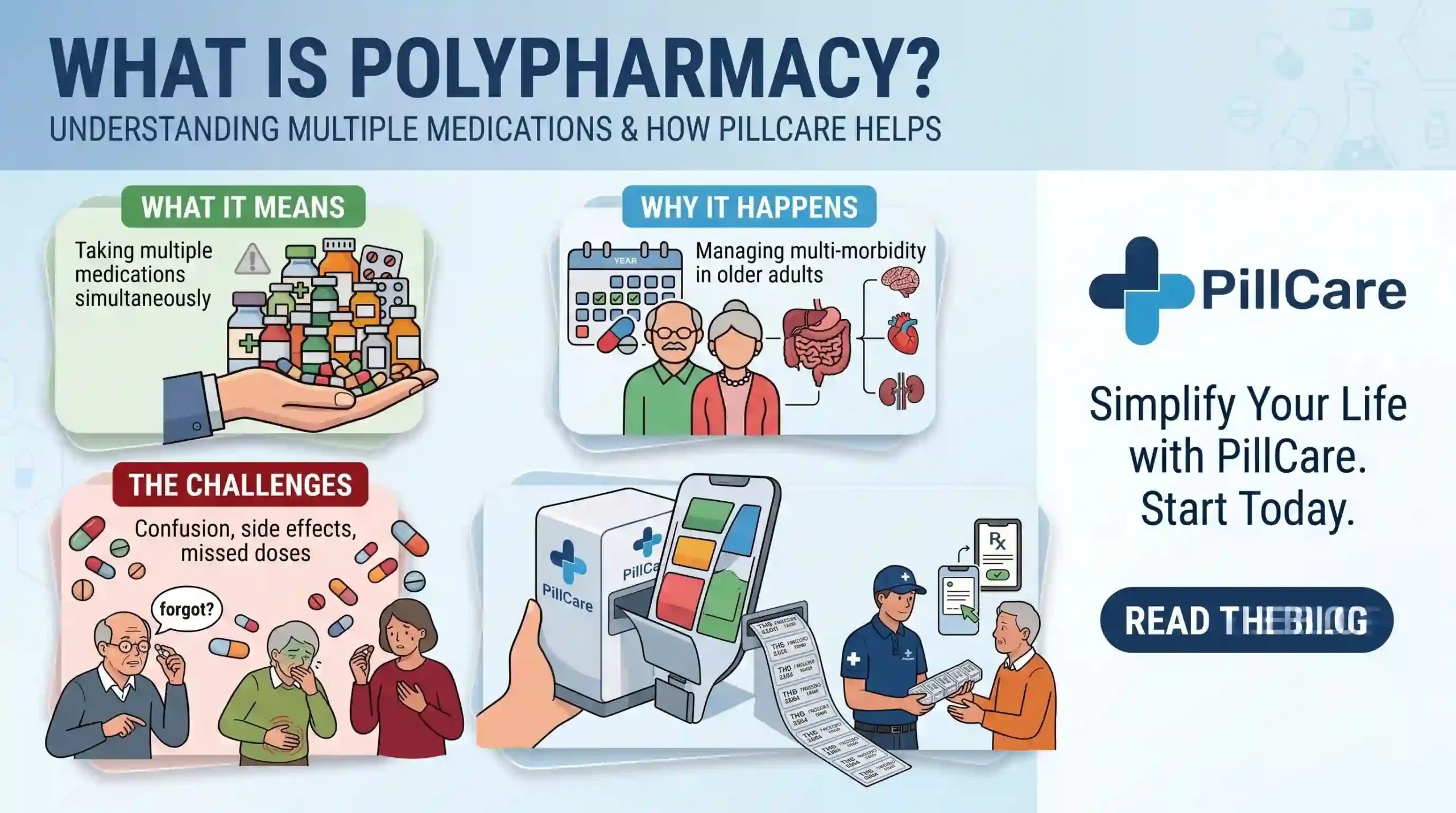
Polypharmacy is when multiple medicines are used at the same time. Usually five or more regular medicines. These medicines may be prescribed drugs, over-the-counter drugs, vitamins or supplements. Many people take many medicines, especially older people who have more than one long-term health problem, such as diabetes, high blood pressure, heart disease or arthritis.
Taking several medicines is not automatically a problem. Many people need multiple medicines to manage their health safely. However, when medicines become difficult to organise, are no longer suitable or increase the risk of side effects, a medication review may be needed.
If you or someone you care for takes several medicines every day, understanding polypharmacy can help you manage medicines more safely and confidently.
What Does Polypharmacy Mean?
Polypharmacy is commonly used to describe someone who takes five or more medicines regularly.
These medicines may include:
- Prescription medicines from your GP or hospital specialist
- Over-the-counter medicines bought from a pharmacy or supermarket
- Vitamins and mineral supplements
- Herbal or complementary medicines
- Medicines taken every day or at regular intervals
Every medicine should have a clear purpose. Your GP or pharmacist will prescribe medicines based on your individual health needs and review them when necessary.
Is Polypharmacy Always a Problem?
No. One of the biggest misunderstandings about polypharmacy is that taking many medicines is automatically harmful. In reality, there are two different types of polypharmacy.
Appropriate Polypharmacy
Appropriate polypharmacy means taking multiple medicines that are:
- Clinically necessary
- Recommended for your medical conditions
- Regularly reviewed by your healthcare team
- Providing more benefit than risk
Problematic Polypharmacy
Problematic polypharmacy happens when medicines become difficult to manage or no longer provide the expected benefits.
This may happen when:
- Medicines are no longer needed.
- Side effects become difficult to manage.
- Medicines interact with each other.
- The medication routine becomes confusing.
- Doses are missed or taken incorrectly.
Why Is Polypharmacy Common in Older Adults?
Many older people have multiple long-term health conditions, and polypharmacy is rising.
For example, one person may receive treatment for:
- High blood pressure
- Diabetes
- High cholesterol
- Arthritis
- Heart disease
- Osteoporosis
- Asthma or COPD
Each condition may require one or more medicines. As treatment changes over time, the number of medicines can gradually increase.
Older adults often receive treatment from different healthcare professionals. As new medicines are added over time, managing the overall medication routine can become more complex without regular reviews.
Examples of Polypharmacy in Older Adults
Multiple Long-Term Conditions
Margaret has diabetes, high blood pressure, and high cholesterol. She takes five prescribed medicines every day. This is a common example of polypharmacy.
common scenarioAppropriate Polypharmacy
David takes medicines for heart disease, arthritis, and asthma. Each medicine has a clear purpose and is reviewed regularly by his GP. This is an example of appropriate polypharmacy.
appropriateWhen Managing Medicines Becomes Difficult
Sarah helps her father organise his medicines because he sometimes forgets doses and finds several medicine boxes confusing. A medication review together with a simpler medication routine may help.
carer supportWhy Can Taking Multiple Medicines Become Challenging?
Taking several medicines every day can become difficult, even when each medicine is necessary.
Many people have medicines that need to be taken at different times. Some should be taken with food, some on an empty stomach and others only once a week. Keeping track of these instructions can become confusing, particularly for older adults or anyone managing medicines for a family member.
Common challenges include:
- Remembering which medicine to take and when.
- Managing medicines with different instructions.
- Ordering repeat prescriptions on time.
- Keeping track of medicine changes after GP or hospital appointments.
- Organising several medicine boxes at home.
- Helping a loved one take medicines correctly every day.
The more medicines someone takes, the more important it becomes to have a simple and organised routine.
What Are the Risks of Polypharmacy?
Polypharmacy itself is not a disease and it does not automatically mean something is wrong. However, managing several medicines can become more difficult over time.
Without regular medication reviews and good organisation, some people may experience:
- Missing doses.
- Taking medicines at the wrong time.
- Accidentally taking an extra dose.
- Confusion about which medicine is for which condition.
- Side effects from medicines.
- Drug interactions between medicines.
- More difficulty following the prescribed treatment plan.
These risks are one reason why GPs and pharmacists regularly review medicines, especially for older adults and people with several long-term conditions.
Warning Signs That Your Medication Routine May Need Reviewing
If you or someone you care for takes several medicines, these signs may suggest it’s time to speak with your GP or pharmacist.
- You often forget whether you’ve taken today’s medicines.
- Medicine boxes are becoming difficult to organise.
- Your medication routine feels confusing.
- You regularly miss doses.
- Medicines have changed several times recently.
- You are unsure what each medicine is for.
- A family member is finding it difficult to manage medicines independently.
These signs do not necessarily mean your medicines are wrong. They simply suggest that your medication routine may benefit from a review or better organisation.
Can Taking Multiple Medicines Increase the Risk of Drug Interactions?
Yes. Taking several medicines can increase the chance of drug interactions.
A drug interaction happens when one medicine affects how another medicine works or increases the chance of side effects.
Interactions can involve:
- Prescription medicines.
- Medicines bought without a prescription.
- Herbal remedies.
- Vitamins and supplements.
Because every person’s medical history is different, it is not possible to say online which medicines are safe or unsafe for you personally.
Never Change Your Medicines Without Medical Advice
If you’re worried about your medicines:
- Speak with your GP.
- Ask your pharmacist.
- Mention every medicine you take, including vitamins and herbal products.
- Request a medication review if your routine has become difficult to manage.
Do not stop, start or change medicines without professional medical advice.
What Is a Medication Review?
A medication review is a discussion with a healthcare professional to check that your medicines are still suitable for your current health needs.
Medication reviews are commonly carried out by:
The aim is to make sure every medicine:
Medication reviews are particularly important for people taking several medicines or whose health needs have changed.
When Should You Ask for a Medication Review?
You may benefit from a medication review if you:
How Can You Manage Polypharmacy Safely?
Managing polypharmacy is not about taking fewer medicines. It is about making sure your medicines are appropriate, reviewed regularly and taken correctly.
Keep an Up-to-Date Medicine List :
- Medicine name.
- Dose.
- When you take it.
- Why you take it.
Bring this list to GP, pharmacy and hospital appointments.
Use One Pharmacy Where Possible
Using one regular pharmacy allows your pharmacy team to maintain a complete record of your prescribed medicines. This can make it easier to identify potential issues and support your GP during medication reviews
Attend Regular Medication Reviews
Your medicines may need to change over time.
Regular reviews help ensure your treatment continues to meet your current healthcare needs.
Tell Your Healthcare Team About Every Medicine
Always mention:
- Prescription medicines.
- Painkillers.
- Vitamins.
- Herbal remedies.
- Supplements.
This gives your healthcare team the full picture when reviewing your medicines.
Never Stop Medicines Yourself
Even if you feel better, continue taking medicines exactly as prescribed unless your GP or pharmacist advises otherwise.
Stopping medicines suddenly can sometimes be harmful.
Practical Tips for Remembering Multiple Medicines
Many people find these simple habits helpful:
- Take medicines at the same time each day whenever appropriate.
- Keep medicines in one safe place.
- Set reminders using a phone or alarm clock.
- Ask a family member or carer for support if needed.
- Check your medicine supply before you run out.
- Arrange repeat prescriptions in advance.
Small changes to your daily routine can make taking medicines easier and help reduce missed doses.
How Can Carers Help Someone Taking Multiple Medicines?
Many people living with polypharmacy receive support from a family member, friend or unpaid carer.
Helping someone with their medicines is about more than handing over tablets. It often includes keeping prescriptions up to date, organising medicines and making sure doses are taken at the right time.
If you’re supporting a loved one, you can help by:
- Keeping an up-to-date list of all medicines.
- Ordering repeat prescriptions before supplies run out.
- Attending GP or pharmacy appointments when appropriate.
- Noting any changes made after hospital visits.
- Encouraging regular medication reviews.
- Helping create a consistent daily medication routine.
If you notice that someone is regularly missing doses or struggling to manage their medicines, speak to their GP or pharmacist. They can review the medication plan and discuss ways to make it easier to follow.
Making Daily Medication Routines Easier
A simple daily routine can make taking multiple medicines easier. Many people find it helpful to keep medicines in one place, use reminders, order repeat prescriptions before they run out and ask about medication pouches if organising medicines becomes difficult.
Can Polypharmacy Be Managed Successfully?
Yes. Many people safely take several medicines for years when their treatment is regularly reviewed and their medication routine is well organised.
Managing polypharmacy is not always about reducing the number of medicines. Instead, the aim is to make sure each medicine is still appropriate, is taken correctly and continues to provide more benefit than risk.
Regular medication reviews, good communication with your GP or pharmacist and using practical tools such as medication pouches can all help make managing multiple medicines easier.
What Are Medication Pouches?
Medication pouches package medications into doses. Instead of opening several medicine boxes throughout the day, your medicines are prepared into clearly labelled pouches.
Each pouch shows important information such as:
This makes it easier to know exactly which medicines are due at each scheduled time.
Medication pouches can be particularly helpful for:
What Are Medication Pouches?
Medication pouches package medications into doses. Instead of opening several medicine boxes throughout the day, your medicines are prepared into clearly labelled pouches.
Each pouch shows important information such as:
This makes it easier to know exactly which medicines are due at each scheduled time.
Medication pouches can be particularly helpful for:
Please note: Medication pouches do not change your prescription. They simply help organise your prescribed medicines into clearly labelled doses, making it easier to follow the treatment plan agreed by your GP or healthcare professional.
How PillCare Supports People Taking Multiple Medicines
Taking several medicines every day doesn’t always require a change in treatment. Often, it simply requires a better way to organise your daily medication routine.
PillCare is designed to help people who take multiple prescribed medicines stay organised and feel more confident about their daily medication routine.
Working with ProCare Pharmacy, PillCare supports patients across the UK by helping coordinate NHS prescriptions and preparing eligible medicines into clearly labelled medication pouches.
Each pouch is arranged according to your prescribed schedule, making it easier to know which medicines should be taken and when.
Our service is particularly helpful for:
What PillCare Does Not Do
It’s important to understand the role of PillCare. PillCare does not:
Decisions about your treatment should always be made by the healthcare professionals responsible for your care. PillCare works alongside your GP and ProCare Pharmacy to help organise and deliver the medicines that have already been prescribed.
Is PillCare Right for You?
PillCare may be suitable if you or someone you care for:
If you’re unsure whether the service is suitable, our team can explain how the process works and answer any questions before you get started.
Why Choose PillCare for Managing Multiple Medicines?
Managing multiple medicines should feel organised, not overwhelming. PillCare works with ProCare Pharmacy to help make your daily medication routine simpler, clearer and easier to follow.
People choose PillCare because we offer:
Our Mission: To help people taking multiple prescribed medicines stay organised and follow the treatment plan agreed with their GP or healthcare professional.
Ready to Make Managing Medicines Simpler?
If you or someone you care for takes several prescribed medicines every day, PillCare can help make your daily medication routine simpler. Working with ProCare Pharmacy, we provide pharmacist-prepared medication pouches, NHS prescription coordination and convenient home delivery for eligible patients.
Find Out More TodayFrequently Asked Questions
What is polypharmacy?
Polypharmacy means taking multiple medicines at the same time, often five or more regular medicines. It is common in older adults and people living with more than one long-term health condition. Taking several medicines is not always a problem, but your medicines should be reviewed regularly by your GP or pharmacist to make sure they remain appropriate.
Is polypharmacy always harmful?
No. Polypharmacy can be appropriate when each medicine has a clear purpose and provides more benefit than risk. It becomes a concern if medicines are no longer needed, cause side effects, interact with each other or become difficult to manage. Regular medication reviews help ensure your treatment remains suitable.
Why is polypharmacy more common in older adults?
Many older adults live with several long-term health conditions such as diabetes, heart disease, arthritis or high blood pressure. Each condition may require one or more medicines, so the number of prescribed medicines often increases over time.
What are examples of polypharmacy in older adults?
An older adult taking medicines for diabetes, high blood pressure, high cholesterol, arthritis and osteoporosis is an example of polypharmacy. Another example is someone prescribed medicines for heart disease, asthma, chronic pain and stomach protection. Whether this is appropriate depends on their individual medical needs and regular medication reviews.
What are the warning signs that managing multiple medicines is becoming difficult?
You should speak with your GP or pharmacist if you:
- Regularly forget to take medicines.
- Miss doses or accidentally take extra doses.
- Feel confused about your medication schedule.
- Have several medicine boxes that are difficult to organise.
- Experience side effects after changes to your medicines.
- Are caring for someone who struggles to manage their medicines.
Can taking multiple medicines increase the risk of drug interactions?
Yes. The more medicines someone takes, the greater the possibility of drug interactions. This includes prescription medicines, over-the-counter medicines, vitamins and herbal supplements. If you have concerns about your medicines, speak with your GP or pharmacist rather than stopping treatment yourself.
What is a medication review?
A medication review is a consultation with your GP, pharmacist or another qualified healthcare professional. They review your medicines to check that each one is still appropriate, working effectively and providing more benefit than risk.
How can I manage polypharmacy safely?
Simple ways to manage multiple medicines include:
- Keeping an up-to-date medicine list.
- Using one pharmacy where possible.
- Attending regular medication reviews.
- Taking medicines exactly as prescribed.
- Telling your healthcare team about all medicines and supplements you take.
- Using an organised medication system if recommended.
How can carers support someone taking multiple medicines?
Carers can help by keeping medicine lists updated, ordering repeat prescriptions on time, encouraging medication reviews, attending appointments when appropriate and helping create a consistent medication routine. If medicines become difficult to manage, they should speak with the person’s GP or pharmacist.
What are medication pouches?
Medication pouches are pharmacy-prepared packs that organise prescribed medicines into individual doses. Each pouch is clearly labelled with the date and time the medicines should be taken, making daily medication routines easier to follow.
Can PillCare help people taking multiple medicines?
Yes. PillCare works with ProCare Pharmacy to support eligible patients who take multiple prescribed medicines. The service helps coordinate NHS prescriptions, prepares suitable medicines into clearly labelled medication pouches and delivers them to your home. PillCare does not prescribe or change medicines; treatment decisions remain with your GP and pharmacist.
Medical Disclaimer
The information on this page is intended for general educational purposes only and should not replace individual medical advice. Polypharmacy and medication management vary depending on your medical history, prescribed medicines and overall health.
Important: Never start, stop or change any medicine without speaking to your GP, pharmacist or another qualified healthcare professional. If you have concerns about your medicines or think you may benefit from a medication review, contact your healthcare provider.
Medical References
This article has been prepared using guidance from recognised healthcare organisations, including:
Clinical guidance may change over time. Healthcare professionals will always consider your individual circumstances before making recommendations about your medicines.
